International Hybrid Parcel Shipping Services
Mercury ships international hybrid parcels for life sciences teams, with courier-controlled pickup, major carrier transit, and pre-departure documentation.
Hybrid Parcel
BioPharma
Diagnostic Kits

When Cross-Border Parcel Compounds the Cost of a Missed Cutoff
The math on a missed international carrier cutoff is different from a missed domestic one. On a domestic lane, a package that misses the afternoon pickup by two hours might still reach the carrier's hub in time for the overnight sortation run. On an international lane, there is no second chance the same evening. International express services operate once daily on most city pairs. A documentation submission that arrives one minute past the carrier's cutoff means the shipment does not move until the following business day -- a full 24-hour delay from what was supposed to be a same-day move.
For pharmaceutical and biotech organizations, this delay rarely stops at inconvenience. A 24-hour hold on a time-sensitive sample, a reagent shipment destined for a clinical site, or a regulated product with a limited stability window can mean the difference between a viable shipment and a discarded one. The delay does not just cost money. It costs product, laboratory time, and in some cases, clinical program continuity.
The standard solution -- booking a full point-to-point international courier on every shipment where timing is uncertain -- solves the problem but at a cost that compounds quickly for organizations with regular cross-border volume. Mercury's international hybrid parcel model offers a third path: a Mercury courier manages the first mile and documentation preparation, and the international carrier handles the transit at commercial parcel rates.
How Mercury's International Hybrid Model Works
The international hybrid model runs in two coordinated legs. In the first leg, a Mercury-managed courier picks up the package at your facility. Unlike a carrier driver operating a fixed route, the Mercury courier is dispatched specifically for your shipment, can collect from facilities with access restrictions, and is not constrained by a route schedule that stops accepting pickups at a set time.
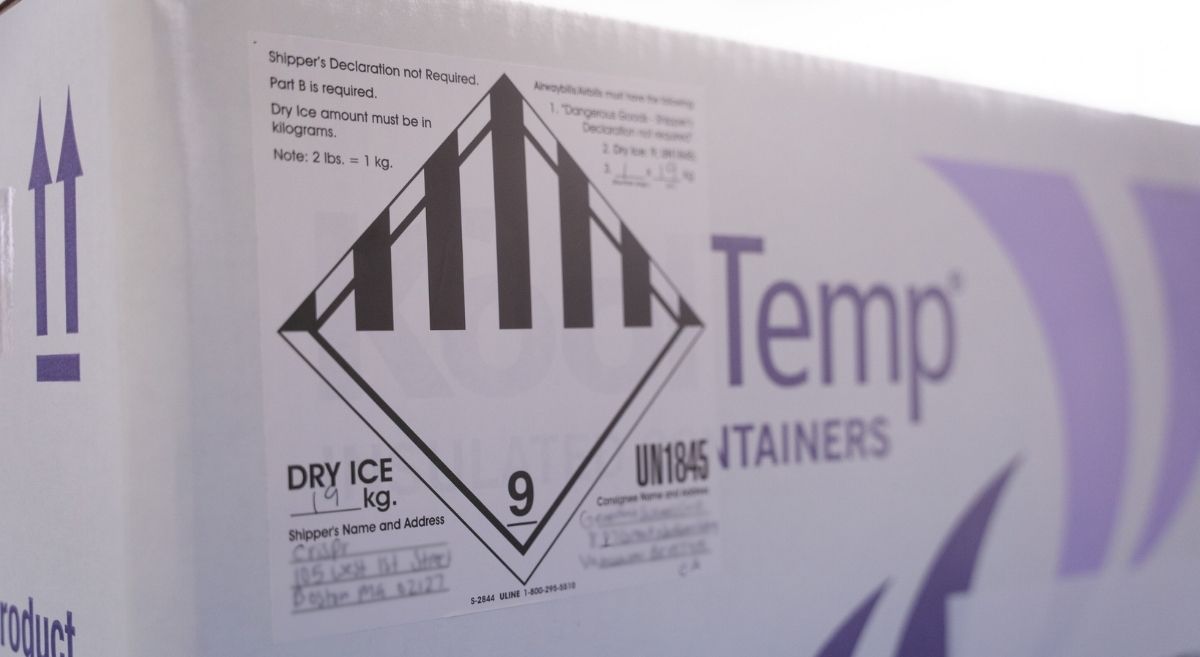
While the courier is in transit to the international carrier's injection point, Mercury's team finalizes the shipment documentation: commercial invoice, airway bill, any applicable dangerous goods declarations, and the pre-advise submission to destination country customs. By the time the courier arrives at the injection point, the package is documented and ready to enter the carrier's international network without delay.
In the second leg, the international carrier transports the package from the injection point to the destination country, handles clearance coordination with Mercury's customs brokerage team, and delivers to the final address. The recipient's experience is identical to a standard international express shipment. The cost reflects the courier leg only, not a full door-to-door international courier rate.
Documentation Before Departure, Not After Landing
The most common source of international parcel delays is not carrier failure -- it is documentation that is incomplete or inaccurate when the shipment reaches the destination country. A commercial invoice with missing fields, an incorrect HTS code, or a shipper's letter that does not match the airway bill will generate a customs query that can hold a shipment for days while the originating facility scrambles to provide corrections from a different time zone.
Mercury's hybrid model builds in a preparation window that standard parcel services do not have. Because the courier leg creates time between the physical pickup at your facility and the injection into the carrier network, Mercury's team uses that window to verify and finalize every document before the shipment crosses the first border. For regulated materials -- pharmaceutical compounds, biological reference standards, controlled substances requiring import permits -- this preparation step is not optional. It is the reason the shipment clears customs without a hold.
Pre-advise to destination customs is filed during this same window. When the shipment arrives at the destination country, customs authorities have already received the entry information. The physical shipment and the customs record arrive together rather than the shipment arriving first and the documentation catching up later.
Carrier Selection and International Network Coverage
Not every international carrier provides the same level of service for pharmaceutical and life sciences cargo. Carrier compliance with GDP (Good Distribution Practice) guidelines, dangerous goods acceptance policies, available temperature-controlled service options, and track record on exception handling all vary by carrier and by trade lane. Selecting the right carrier for a specific origin-destination pair and product profile is a decision that affects both compliance and delivery reliability.
Mercury selects international carriers based on the specific requirements of each shipment: the destination country's regulatory environment, the product's temperature and handling requirements, the service level needed for the delivery timeline, and the carrier's known performance on that trade lane. For lanes where carrier compliance gaps are well-documented, Mercury routes around those carriers rather than booking on price alone.
The injection point used in the hybrid model is also carrier-dependent and route-dependent. Mercury's team identifies the correct hub or airport facility for each shipment to ensure the package enters the carrier's network at the point that gives it the best chance of meeting the stated transit time, not just the nearest location.
Temperature Management Across Longer International Routes
International parcel routes are longer than domestic ones -- often 24 to 72 hours in transit depending on the lane, with additional time possible if clearance at the destination country takes longer than the published service standard. Packaging that is validated for a 24-hour domestic transit is not automatically suitable for a 48-hour international one. The extended duration, combined with the potential for delays at customs, requires packaging selected for the specific route rather than the published transit time alone.
Mercury selects cold chain packaging for international hybrid parcel shipments based on the actual route duration, the temperature range required, the ambient conditions along the route, and a buffer for potential holds. For shipments moving between regions with significant seasonal temperature variation -- North America to Europe in summer, or Asia Pacific in humid conditions -- packaging performance at ambient extremes is part of the selection criteria, not an afterthought.
Temperature records are maintained across both legs of every international hybrid shipment where temperature control is required. The courier leg, the wait time at the injection point, the carrier transit, and any time in a customs holding area all generate a continuous temperature record. This matters for pharmaceutical products where a quality review requires evidence of the full transit history, including the legs that occurred before the carrier's tracking record begins.
First-Mile Reliability on Cross-Border Shipments
Cross-border shipments that miss their pickup face a more severe consequence than a missed domestic pickup. An international carrier that does not collect a package on its scheduled day does not simply route it to the next domestic hub. The shipment has to be rebooked on the next available international service, documentation may need to be revised, and in some cases the carrier imposes rebooking penalties. For facilities that have experienced carrier no-show events, this is not a theoretical risk.
Pharmaceutical and biotech facilities often present challenges that standard carrier pickup routes are not designed for. Controlled access entrances, security check-in procedures, on-site receiving protocols, and loading dock windows that close at specific times are common at research campuses, hospital pharmacies, and manufacturing sites. A carrier driver operating a route with 20 stops will not wait for a security process to complete if doing so affects the rest of the route.
Mercury's courier is dispatched for your facility specifically. The access requirements are communicated before departure. If the facility has a procedure the courier needs to follow, the courier follows it. This first-mile control is what the international hybrid model is built on: a courier who is accountable to a single pickup, not a route, combined with a major international carrier whose network coverage and transit reliability no dedicated courier can match at scale. For life sciences organizations with regular cross-border parcel volume, that combination is what makes the hybrid model operationally reliable rather than just cost-efficient.
Who Uses International Hybrid Parcel
Mercury's international hybrid parcel service is used by pharmaceutical manufacturers shipping stability samples or reference standards to overseas testing laboratories, by clinical research organizations coordinating biological material transfers between sites in different countries, by biotech companies sending reagent kits or reference panels to international distribution partners, and by organizations whose facilities have access conditions that standard international carrier pickup routes cannot reliably accommodate.
It is also the right option for organizations that have experienced documentation errors on international parcel shipments -- where the broker receives a hold notification from destination customs because something in the paperwork was incomplete or inconsistent. The hybrid model does not just improve pickup reliability. It removes the documentation gap that most international parcel delays trace back to.
For cross-border shipments that are straightforward in terms of access and documentation, Mercury's international parcel service may be the simpler fit. When the pickup is complex, the documentation is regulated, or the product cannot absorb a missed cutoff, the international hybrid model is the purpose-built alternative.