Shipping Lithium-Ion Batteries: UN3480 & UN3481 Regulations
General
Key takeaways
UN3480 covers batteries shipped alone; UN3481 covers batteries packed with or contained in equipment.
As of January 1, 2026, UN3481 batteries above 2.7 Wh must comply with the 30% state-of-charge limit for air transport.
UN3480 batteries are categorically prohibited on passenger aircraft, regardless of watt-hour rating.
Watt-hour rating determines which packing instruction applies, whether a DGD is required, and which aircraft types are permitted.
Missing a single label or marking is grounds for rejection at the carrier sort facility.
For life sciences organizations, a rejected battery shipment can trigger downstream cold chain failure.
Lithium-ion batteries power medical devices, diagnostic kits, research equipment, and industrial tools. That reach makes them one of the most commonly shipped dangerous goods, and one of the most closely regulated. UN3480 and UN3481 are the two classifications that govern virtually every commercial lithium-ion battery shipment, and the rules that apply to each changed materially in 2026.
UN3480 covers lithium-ion batteries shipped on their own, without any associated device or equipment.
UN3481 covers lithium-ion batteries packed with equipment (in the same box as the device) or contained in equipment (installed inside the device).
Getting the classification right is the first decision. Getting everything else right depends on it.
What Changed in 2026
The 67th Edition of the IATA Dangerous Goods Regulations, effective January 1, 2026, extended the state-of-charge (SoC) limit for lithium-ion batteries transported by air.
Under the previous rules, only UN3480 shipments were required to travel at 30% SoC or below. Starting January 1, 2026, that requirement became mandatory for UN3481 as well. Specifically, lithium-ion batteries packed with equipment where cells or batteries have a watt-hour rating greater than 2.7 Wh must now be offered for transport at no more than 30% of their rated design capacity.
Batteries contained in equipment carry this same limit as a strong recommendation, not yet a mandate. The distinction matters for compliance planning.
The 2026 update also introduced updated guidance documents from IATA clarifying classification pathways for lithium and sodium-ion batteries. Shippers relying on documentation prepared before January 2026 should verify it reflects the current edition.
UN3480: Batteries Shipped Alone
Shipping lithium-ion batteries without any associated equipment triggers the strictest requirements under both IATA and IMDG.
Batteries must be protected against short circuits, typically using non-conductive separators, inner packaging, or terminal caps. State of charge must not exceed 30% of rated design capacity. Outer packaging must withstand pressure changes, vibration, and shocks throughout transit.
Every UN3480 air shipment requires a Shipper's Declaration for Dangerous Goods (DGD). The airwaybill must state that dangerous goods are attached. For shipments moving by cargo aircraft, the Cargo Aircraft Only designation must appear on both the declaration and the package.
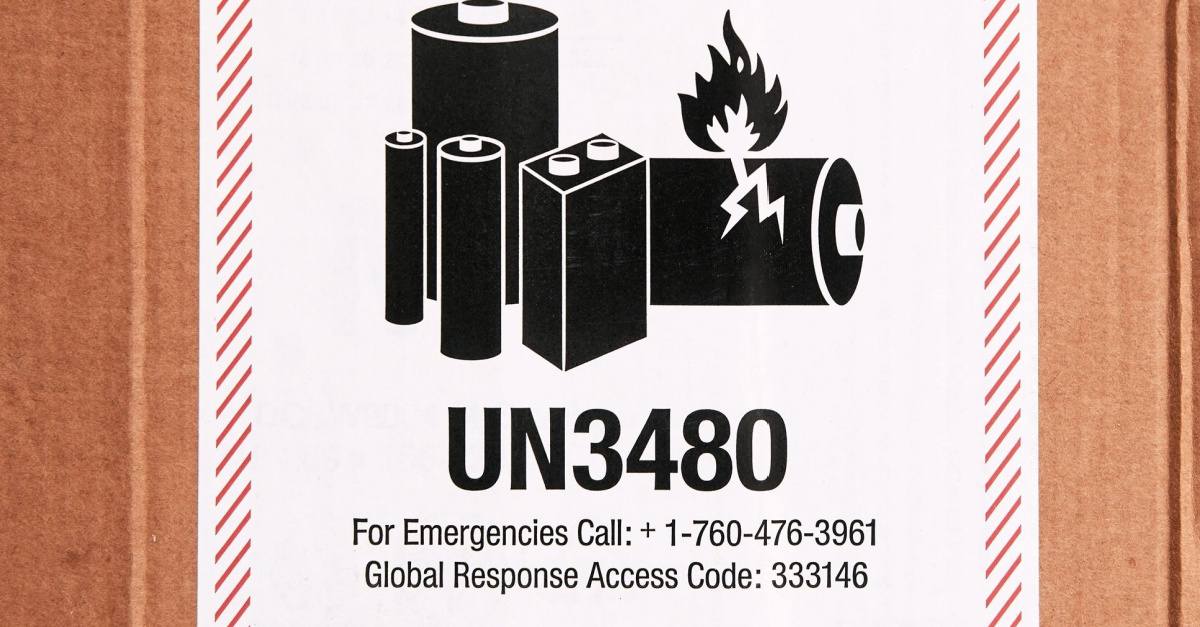
Each package must display a Class 9 hazmat label, the UN3480 marking, and where applicable, the Cargo Aircraft Only label. All markings must be durable and legible.
UN3480 batteries are prohibited as cargo on passenger aircraft regardless of watt-hour rating. This is not a threshold question, it is a categorical restriction.
UN3481: Batteries With Equipment
When batteries travel with or inside a device, UN3481 applies. The requirements are less demanding than UN3480 in some respects, but the 2026 SoC update closes a gap that previously made UN3481 air shipments simpler to manage.
Batteries must be fully enclosed in inner packaging and secured within a strong outer container. Packaging must prevent movement that could cause short circuits or damage. The number of batteries is limited to what is needed to power the equipment, plus no more than two spares.
The DGD exemption threshold: if individual cells are 20 Wh or below and batteries are 100 Wh or below, a Shipper's Declaration is not required. This reduces paperwork for small shipments, but it does not remove the SoC requirement that took effect in 2026 for batteries above 2.7 Wh.
Packages must bear Class 9 hazmat labels where required. The UN3481 marking must appear on outer packaging. A Lithium Battery Handling Label is required for certain air shipments depending on the packing instruction applied.

UN3480 vs UN3481: What Goes on the Package
A question that comes up consistently in air cargo operations: what does a correctly labeled UN3480 or UN3481 package require?
For UN3480, the package must show the Class 9 diamond label, the Cargo Aircraft Only label, the UN3480 marking with proper shipping name and UN number, and the net quantity of batteries inside.
For UN3481, the package must show a Class 9 diamond label where applicable, the UN3481 marking, and the Lithium Battery Handling Label for applicable packing instructions. Whether the Cargo Aircraft Only label applies depends on watt-hour rating and packing instruction.
Missing any one of these elements is grounds for rejection at the carrier's sort facility.
Watt-Hours: Why the Calculation Matters
Watt-hour rating determines which packing instruction applies, whether a DGD is required, and whether passenger aircraft transport is permitted. The calculation: multiply nominal voltage by amp-hour capacity.
For cells, the relevant threshold is 20 Wh. For batteries, it is 100 Wh. Shipments within these limits under UN3481 may qualify for reduced documentation. Shipments above these limits require full dangerous goods documentation.
Many compliance errors trace back to incorrect or undocumented watt-hour ratings. Battery specifications should be verified against the manufacturer's data sheet, not assumed from the device label.
Common Compliance Mistakes
Misclassification between UN3480 and UN3481 is the most frequent error. A power bank shipped without a device is UN3480. The same power bank shipped in the same box as the device it charges is UN3481. The distinction is determined by what else is in the package, not by the battery itself.
Missing or outdated documentation is the second most common issue. DGDs prepared under prior IATA editions may not reflect the 2026 SoC mandate for UN3481. Any documentation that does not address state of charge for packed-with-equipment shipments above 2.7 Wh should be reviewed before the next shipment.
Exceeding state-of-charge limits is now a compliance violation for both UN3480 and UN3481 air shipments. Batteries must be measured and documented at or below 30% SoC before tender to the carrier.
Lithium-Ion Batteries in Life Sciences and Healthcare
For organizations in pharmaceutical, biotech, and clinical research, lithium-ion battery shipments rarely arrive as primary cargo. They accompany diagnostic instruments, monitoring devices, portable infusion pumps, and field research equipment. For a closer look at the specific compliance requirements for battery-powered medical hardware, see Mercury's guide to shipping regulations for medical devices.
Live cell shippers present a particular overlap: active shipping systems such as Cellbox Flight use both UN3481-classified lithium-ion batteries and UN1845 dry ice simultaneously. A rejection on either element can compromise the entire shipment. For more on managing these combined dangerous goods requirements, see Live Cell Shipping: Time-Critical Logistics Guide.
A delayed or rejected battery shipment can halt a clinical trial site, ground a mobile diagnostic unit, or interrupt patient monitoring. When time is critical and no delay is acceptable, Mercury's next flight out service provides same-day air coordination with full dangerous goods documentation support.
Mercury manages dangerous goods logistics for life sciences and medical device organizations, including proper classification, documentation, and carrier coordination for UN3480 and UN3481 shipments. For help with a specific shipment or program, contact our team.
Related Resources
For guidance on biological substance classification and when dangerous goods rules apply alongside UN3373 or Category A requirements, see Classifying Biological Shipments Safely.
For guidance on shipping biological specimens alongside diagnostic equipment, see IATA Biological Packaging: PI650, PI620, and PI954.
For information on Class 7 radioactive material classifications relevant to radiopharmaceutical devices with battery-powered monitoring components, see Class 7 Radioactive Materials: Shipping Classification Guide.
For dry ice labeling requirements that often apply alongside UN3481 in active cold chain shipments, see Dry Ice Packaging and Labeling Instructions.
For cold chain packaging options used with temperature-sensitive medical devices, see Specialty Cold Chain Shipping Services.
Start shipping today!
Start your shipment now — no login required. Fast, secure, and guided by experts.