Inside Mercury's Bravo Squad with Santino Hipsley
General
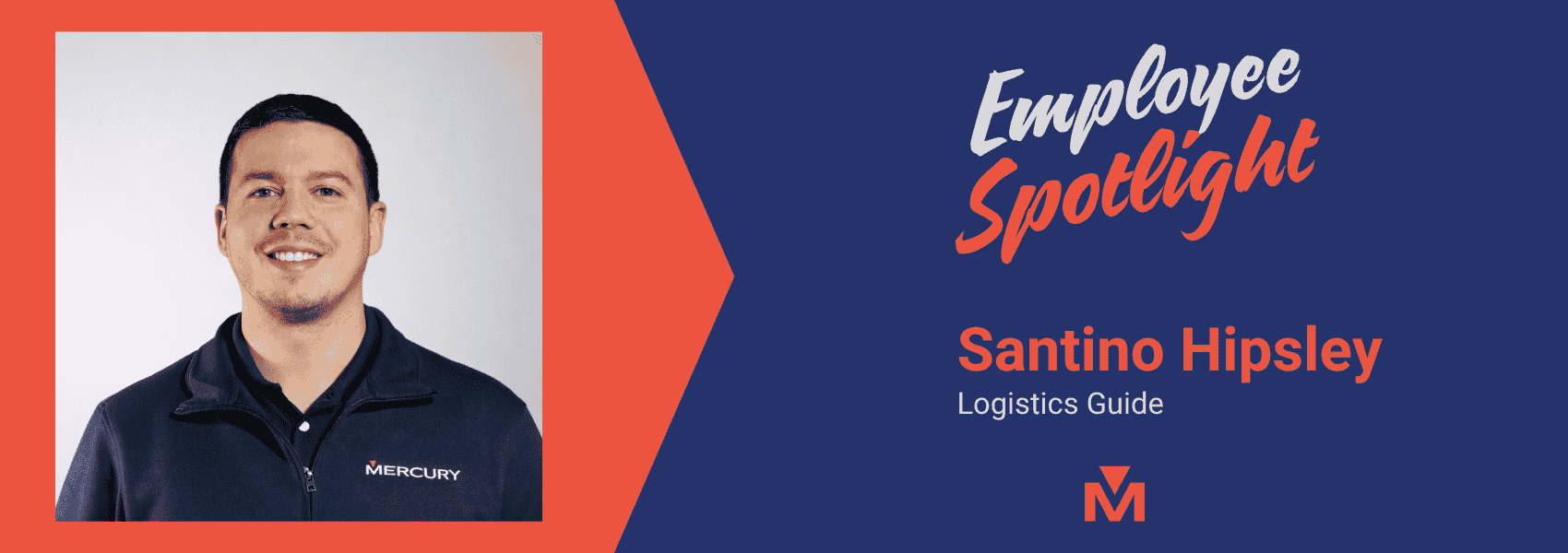
Meet Our People - Santino Hipsley
At Mercury, every shipment depends on people who combine operational precision with genuine accountability. Santino Hipsley, a Logistics Guide on the Bravo Squad, is a strong example of both. Since joining Mercury, Santino has become a trusted member of a team that manages some of the most complex, time-sensitive, and temperature-controlled shipments in healthcare and life sciences logistics. He approaches every request with the same discipline: start with the big picture, validate every detail, and keep clients informed at every step. Beyond his day-to-day responsibilities, Santino is also actively contributing to the development of Sierra Squad, Mercury's newest team, helping build the processes and standards that will shape the next phase of the company's growth.
Can you tell us about your background and what led you to a career in logistics, particularly within the healthcare and life sciences space?
I have always enjoyed being around people and solving problems. I grew up in a small village in Northeast Ohio. In the summer of 2015, one of my best friends, Ridge, invited me to stay with him while he finished his final semester at The Ohio State University. I came down to Columbus and never left.
I worked as a server for my first handful of years in Columbus and I loved it. Being around people and working in a fast-paced environment was perfect for me. Once Covid happened, I needed to transition to something more stable. I worked briefly for a medical supply company and a hospital until I found a job with our city's Metro Parks, while also officiating basketball for Columbus Parks and Rec.
After that, I found myself working for an LTL carrier where I was introduced to the world of logistics. I instantly knew it was something I could excel in. Lots of people, lots of problems. Looking back, it took me about ten years to go from serving hot coffee in the morning to shipping temperature-sensitive shipments globally.
What drew you specifically to Mercury, and what was your first impression of the Bravo Squad when you joined?
I was looking for a new challenge. Coming from an LTL carrier, the work had become repetitive, and I wanted something that required more critical thinking and attention to detail.
Mercury stood out immediately because of the complexity, especially around cold chain and time-sensitive shipments. From the beginning, it was clear that nothing is taken lightly here. Every detail matters, and there is a real sense of accountability behind every shipment.
When I joined Bravo Squad, what stood out most was how nimble and collaborative the team was. We are a small group, so everyone plays a critical role, and there is a strong level of trust in how we support each other across different service levels.
Can you walk us through what a typical day looks like for you as a Logistics Guide on the Bravo Squad?
My day starts with getting fully up to speed. I review updates and notes from second and third shift, check on active shipments, respond to any new client requests, and provide disposition wherever I can.
From there, we align as a team to set expectations for the day and identify any potential risks or gaps early. That helps us stay proactive instead of reactive. Once that is done, it is full systems go. I am actively tracking shipments, coordinating new bookings, communicating with clients, and resolving issues.
Right now, a unique part of our workflow is that Bravo Squad is also helping build out Sierra Squad, Mercury's newest team. So we are not only managing active operations but also developing new processes and helping scale a team at the same time. That adds another layer of complexity but also makes the work twice as rewarding.
How do you approach the coordination of time-sensitive and temperature-controlled shipments from the moment a request comes in to final delivery?
The key is balancing big-picture awareness with attention to detail. You need both to keep a shipment moving smoothly from start to finish. I start by looking at the shipment from a high level to understand the full scope, timelines, stakeholders, and any risks involved. From there, I break it down step by step, validating details like packaging, temperature requirements, pickup and delivery windows, routing, and documentation.
Once the shipment is in motion, I stay closely engaged, monitoring progress and tracking milestones while trying to anticipate issues before they escalate. All of this happens while maintaining communication with our clients and providing them with timely updates.
What tools, systems, or habits help you stay organized and proactive when managing multiple critical shipments at once?
Our Mercury Portal is a huge advantage. Having everything our clients need to ship alongside everything I need to track shipments in one place makes a real difference. The Portal is constantly being improved, and I have seen not only my colleagues' ideas but our clients' requests go live as updates. That is pretty remarkable.
We also use a strong ticket management system. Everything comes through one place: emails, shipment update requests, new bookings, live chats. Combined with the Portal, it removes the friction of jumping between multiple systems and allows me to streamline my workflow.
I also work one of Mercury's weekend shifts, Sunday mornings. I rely heavily on the other squads to keep their shipments updated so I can act on anything if needed. The people at Mercury, combined with the systems in place, make it easy to pick up where others left off and continue serving our clients without missing a beat.
What do you find most challenging about working in specialized healthcare logistics, and how have you developed strategies to handle it?
Attention to detail will get you. Helping our clients import and export shipments across the world requires careful focus on the smallest things. A single wrong number or letter can go a long way in delaying a shipment. The best way to prevent this is to always check your work, implement checkpoints in your process to confirm details, and ask teammates to review before finalizing.
Beyond accuracy, the bigger challenge is always time and weather. Pilots run out of hours, so a flight gets rescheduled. A snowstorm hits the northeast coast. The best counter to both is having a backup plan ready before you need it. Whether that means rebooking to a different airline or having a driver on standby for a weather recovery, contingency thinking is part of the job.
Can you walk us through a shipment that did not go as planned and how you and your team worked through it?
With any shipment that is delayed or not going as intended, we approach it the same way: by being upfront and honest. In healthcare and life sciences logistics, clients do not want surprises, especially when timelines are critical. Even if we do not have every answer immediately, transparent communication is always the starting point.
Most of these situations require collaboration across teammates, local partners, airlines, and more. Once things start to deviate, the best course of action is to immediately work with all parties to realign the timeline and reset expectations. It is never easy being the bearer of bad news, but transparency goes a long way.
Is there a specific shipment or client interaction that has stayed with you?
I enjoy the interactions with people who are not expecting it. It could be a weekend email updating a client, a phone call to a lab tech, or simply helping someone who was not anticipating the level of support we provide. I try to treat every person and every shipment with the same respect and consideration, regardless of the circumstances.
Every day is an opportunity to strengthen relationships and build trust, and that is something I take seriously.
What does it mean to you personally to know that the shipments you manage may be supporting medical research or patient care?
It is a good feeling knowing that my work contributes to something larger. Knowing that these shipments can support research or patient care makes me more disciplined and more intentional in how I handle every detail. There is less room for error, and that pushes me to operate at a higher level.
It has also changed the way I think about accountability. Clients trust me with shipments that are often extremely valuable, highly sensitive, and time critical. That level of trust motivates me to continuously improve, stay adaptable, and provide the highest level of service possible.
Outside of work, what hobbies or activities help you recharge and bring a fresh perspective back to the job?
Outside of work is where I like to think I do my best work: being a dad. I have an almost three-and-a-half-year-old daughter, Ruby. We spend our time visiting libraries, parks, the zoo, and everything else Columbus has to offer. This summer I am looking forward to biking again, this time with a carriage for Ruby, and catching a Columbus Clippers or Crew game along the way.
When I have time to myself, you can usually find me on the golf course. I am a competitive person, and golf gives me the chance to challenge myself both physically and mentally. These things combined, mainly Ruby, do an excellent job of keeping me grounded.
Join Our Team: Discover Career Opportunities at Mercury
If Santino's story resonates with you, Mercury is growing. We are looking for self-motivated, collaborative people who care deeply about getting the details right. Visit our Careers page to learn about open roles and what it means to be part of a team like Bravo Squad.
Start shipping today!
Start your shipment now — no login required. Fast, secure, and guided by experts.