Clinical Trial Kit Building for IMP Sponsors
General

Key takeaways
IMP kit assembly must take place in a GMP-compliant environment and follow the sponsor's protocol before any distribution begins.
Each kit component, including the investigational product, ancillary supplies, and patient instructions, requires individual documentation and labeling.
EU Clinical Trials Regulation 536/2014 applies to all new trials since January 2023 and sets unified labeling requirements across EU member states.
Blinded trials require matching placebo packaging and identical kit configurations across all arms to prevent unblinding during transit.
Cold chain validation must cover the full outbound journey from depot to site or patient, not just the primary transport leg.
Logistics partners must integrate kit tracking with clinical trial management systems to maintain inventory visibility across all active sites.
Build Compliant IMP Kits That Reach Every Site
Clinical trial kit building sits at the center of your supply chain. It connects manufacturing, regulatory compliance, patient safety, and logistics into a single outbound process. When it works well, investigational sites receive everything they need, in the right condition, at the right time. When it fails, patient dosing schedules slip and trial timelines suffer.
This guide covers what sponsors, CROs, and supply chain teams need to know about building and shipping IMP kits compliantly and efficiently.
What Is Clinical Trial Kit Building?
Clinical trial kit building, also called IMP assembly or clinical supply packaging, is the process of assembling investigational medicinal products and all required ancillary materials into site-ready or patient-ready kits.
A complete kit typically contains the IMP itself, administration supplies, patient diaries or eDiary devices, sample collection materials, temperature monitoring devices, return packaging, and printed instructions. Each component must match the protocol's specifications exactly.
Kit assembly must take place in a GMP-compliant facility under 21 CFR Part 211 or the equivalent EU GMP Annex 13 standard. This applies whether the sponsor assembles kits in-house or delegates assembly to a CMO or third-party packager.
IMP Labeling: The Non-Negotiable Starting Point
Every IMP kit that leaves the depot must carry a label that satisfies the regulatory requirements of each destination country. The FDA and the European Medicines Agency set different but overlapping standards for investigational product labeling.
At minimum, an IMP label must include the protocol number, sponsor name, product name and dose, route of administration, lot number, expiry date, storage conditions, and the statement "For Clinical Trial Use Only." International kits often require local language translations alongside English text.
EU Clinical Trials Regulation 536/2014, in effect for all new trials since January 2023, introduced unified labeling requirements across EU member states. Sponsors running global trials must map labeling requirements by country before kit assembly begins, not after distribution starts.
Blinded Trials: Matching Kits Across Arms
Blinded clinical trials add a packaging challenge that open-label trials do not face. The IMP and placebo must arrive at the site in identical kit configurations. Any visible difference between treatment and control kits creates an unblinding risk.
Packaging must match in size, weight, appearance, and labeling across all arms. Where the IMP and placebo differ in physical properties, secondary packaging bridges the gap. Sponsors must validate that blinding holds across the full distribution chain, including cold chain packaging for temperature-sensitive products.
Site staff who open kits must not be able to identify a participant's treatment arm from the packaging alone. Build this check into kit design, not site training.
Cold Chain Packaging for IMP Kits
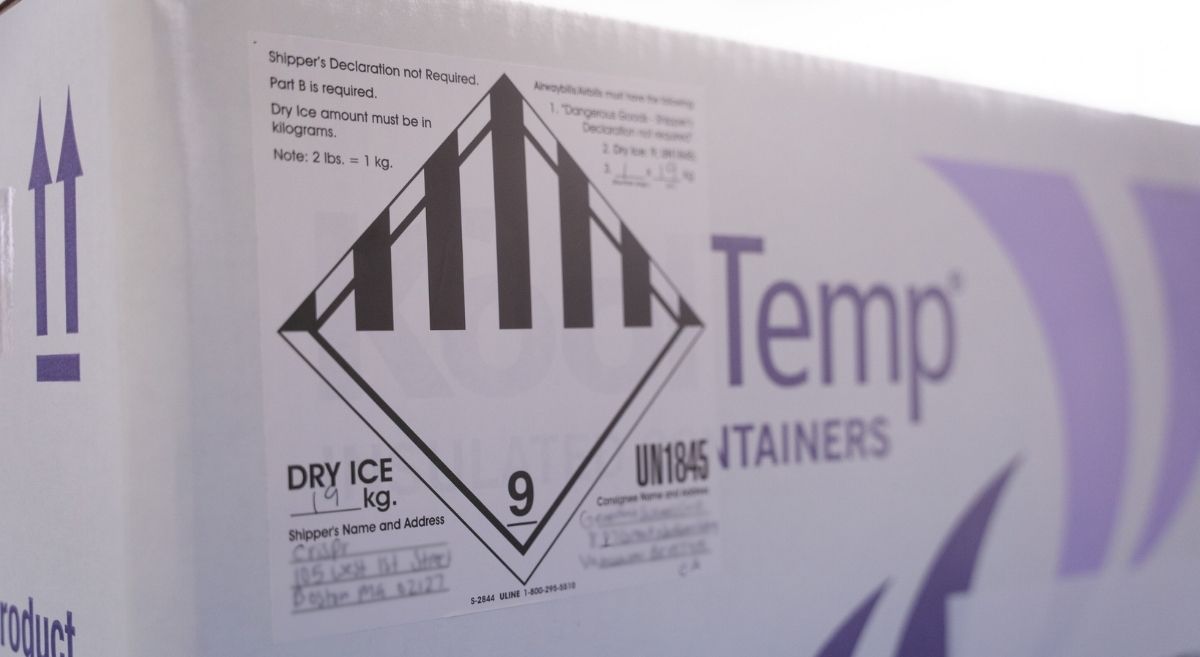
Many IMPs require temperature-controlled distribution. Biologics, cell therapies, and certain small molecules ship at 2 to 8°C or below. Each temperature range requires a validated packaging system that maintains conditions from depot departure to site receipt.
Specialty cold chain services validate packaging performance across worst-case transit scenarios, including seasonal temperature extremes and extended transit times. A packaging system validated for summer lanes may perform inadequately in winter routes, and vice versa.
Include a calibrated data logger in every temperature-sensitive kit. The logger provides a continuous record from pack-out to delivery and satisfies Good Distribution Practice requirements. It also supports site-level excursion investigations when deviations occur.
Documentation That Must Travel With Every Kit
Each outbound IMP kit requires a documentation package that travels with the shipment. Missing documents cause site refusals and compliance gaps that require corrective action before dosing can resume.
The standard documentation set includes a packing list with lot numbers and quantities, the investigator's product information sheet, randomization codes for open-label arms, import permits for international destinations, and temperature monitoring device instructions.
Trials operating under a Risk Evaluation and Mitigation Strategy program must include REMS materials as required by the FDA. For international shipments, prepare country-specific import documentation in advance. Maintain a complete chain of custody record that captures every transfer point from depot to site.
Depot Strategy and Site Distribution
The depot network directly affects how quickly kits reach active trial sites. Sponsors running global programs need regional depot access to reduce transit times and limit cold chain exposure across long international routes.
Position depot inventory close to the highest-enrollment sites and highest-risk lanes. Build minimum stock levels into the resupply protocol to prevent site stockouts during enrollment surges. Coordinate depot selection with your logistics partner before the first patient enrolls.
For trials using direct-to-patient delivery, the outbound kit must reach a residential address within validated temperature conditions. This adds packaging and scheduling complexity that site-based distribution does not require. Mercury's direct-to-patient logistics capabilities support both hub-and-spoke and home delivery models within a single program.
Integrating Outbound Kits with Reverse Logistics
IMP kits rarely travel one way. Sites return unused product, expiring inventory, and reusable cold chain components at multiple points throughout the trial. Design the outbound kit to support the return flow from day one.
Include pre-labeled return packaging and clear return instructions in every outbound shipment. Align return schedules with resupply cycles to reduce site burden. For reusable shippers and data loggers, define the retrieval, revalidation, and redeployment process before the first shipment leaves the depot.
Mercury's reverse logistics program for clinical trial kits handles return coordination, temperature-monitored transport, and component redeployment as part of an integrated supply chain model.
How Mercury Helps Sponsors Focus on Research
Managing IMP kit outbound logistics requires carrier coordination, GDP-aligned documentation, cold chain validation, and real-time inventory tracking across multiple sites and geographies. Mercury specializes in clinical trial logistics for pharma and biotech sponsors who need reliable kit distribution without adding internal operational overhead.
Mercury manages outbound kit scheduling, carrier selection, customs documentation, and temperature monitoring for domestic and international trial sites. Our team operates 24/7, which means your supply chain does not stop when issues arise outside business hours.
We integrate kit tracking with your clinical trial management system to give sponsors and CROs real-time visibility into kit status, delivery confirmation, and temperature records at every active site.
Mercury handles the logistics complexity so your team can stay focused on running the trial.
Contact Mercury today to build an IMP kit distribution strategy that protects your trial timeline and keeps every site supplied on schedule. Reach our team here.
Start shipping today!
Start your shipment now — no login required. Fast, secure, and guided by experts.