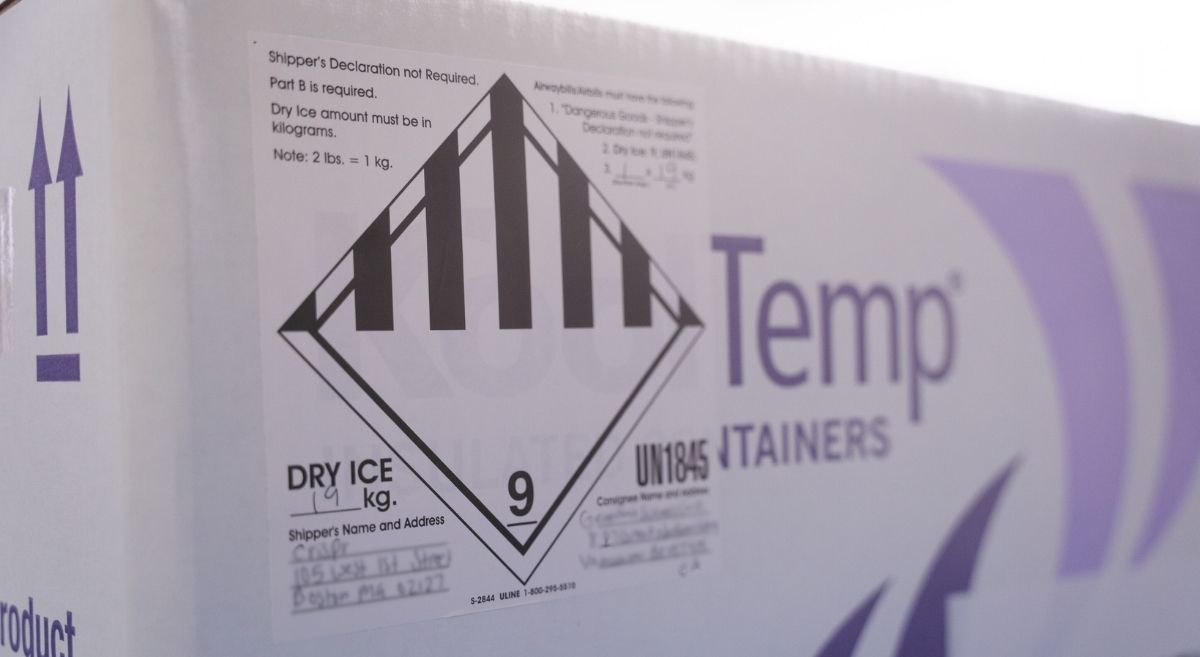
Biological sample shipping: express or airline?

Key takeaways
Biological samples move through four main channels, which are local ground couriers, express integrators, airline cargo with managed ground legs, and onboard couriers, and each carrier sets its own acceptance rules.
Express carriers suit routine, well-packaged shipments that fit a scheduled network and its cutoffs, while airline cargo suits urgent or high-value shipments that need a specific flight and more control at each handoff.
Sample stability, coolant duration and the receiving laboratory's hours should decide the route before price or advertised transit time.
Next day delivery is possible on many domestic lanes, but weekends, holidays, customs and missed cutoffs can break the schedule, so a backup plan matters.
A shipment is complete for the study or test only when the laboratory receives and accepts the sample, not when tracking shows delivered.
Biological sample shipping can travel by express carrier, by airline cargo booked on a specific flight, or by a dedicated courier who keeps the package in hand. The right choice depends on how long the specimen stays usable, what coolant it needs, how far it is going and when the receiving laboratory can accept it. Express networks are usually the efficient choice for routine, well-packaged shipments that fit their cutoffs. Airline cargo with managed pickup and delivery is usually the better fit when timing is tight, the sample is hard to replace, or the package may need attention on the way.
A biological sample courier ties those pieces together. This guide explains which couriers deliver biological samples, how express vs airline shipping of biological samples compares, how biological sample transport works from collection to receipt, and how fast samples can realistically move.
Which couriers deliver biological samples?
Biological samples are delivered by four broad types of provider: local and regional ground couriers, express integrators that run their own air and ground networks, airlines that carry accepted cargo between airports, and onboard couriers who travel with the shipment. Many shipments combine more than one of them, coordinated by a specialist life science logistics provider.
The question of which couriers deliver biological samples has no single answer, because acceptance depends on the material, its classification, the packaging, the coolant, the route and the account set up with the carrier. Each carrier publishes and updates its own conditions, so confirm acceptance for the exact contents before you book.
Express integrators
Large express carriers move eligible biological samples through scheduled overnight and international networks. Many offer dedicated healthcare services. For example, DHL Express describes its healthcare shipping options as including Medical Express, a solution for regulated biological substances with priority handling in its express network and ambient, chilled, frozen and dry ice temperature ranges. Services like this are typically tied to an account and to the carrier's own rules, so a service name alone does not prove your shipment qualifies.
Postal service
The US Postal Service accepts some biological materials with strict limits. Under USPS Publication 52, section 346, the highest-risk infectious substances are not mailable at all, and certain regulated biological materials may only be mailed for specific medical, research or laboratory purposes through Priority Mail or Priority Mail Express, in triple packaging with quantity limits. Mail is rarely the right channel for time-critical or temperature-critical samples.
Airlines and airline cargo
Passenger and cargo airlines carry accepted biological shipments airport to airport. The airline does not usually collect the package from the clinic or deliver it to the laboratory, so a courier handles the first and last legs, tenders the package at the cargo terminal and recovers it on arrival. Airline acceptance rules, cargo cutoffs and dangerous goods limits for coolants such as dry ice apply to each booking.
Ground couriers and onboard couriers
Local couriers handle same-day pickups and deliveries between collection sites, hospitals and laboratories. In the US, the Hazardous Materials Regulations include a narrow exception at 49 CFR 173.134(b)(10) for certain patient samples and biological products, other than the highest-risk category, carried by a private or contract carrier in a motor vehicle used exclusively to transport such materials. That exception applies only to road transport under its stated conditions and does not cover air legs. Onboard couriers travel on a commercial flight with the shipment, which keeps one person responsible for the package from pickup to delivery. Mercury's onboard courier service describes this option.
Should you ship biological samples by express carrier or airline?
Ship biological samples by express carrier when the package is routine, fully qualified for the transit time, accepted by the carrier and able to make the network cutoff. Choose airline cargo with managed ground legs when the sample is urgent, hard to replace, close to the limit of its stability window, or likely to need coolant replenishment or close monitoring along the way.
The comparison below uses the criteria that usually decide the route.
Criterion | Express carrier | Airline cargo with managed pickup and delivery |
|---|---|---|
How it moves | Through the carrier's scheduled hubs and sort centers | On a specific booked flight, with couriers handling both ground legs |
Timing control | Fixed pickup cutoffs and delivery commitments for each service level | Flight chosen to fit the collection time and lab receiving window |
Handling | Many handoffs inside an automated network | Fewer, known handoffs at the origin and destination cargo terminals |
Access during a delay | Limited, intervention depends on the carrier's own procedures | A courier can recover the package, check it and arrange coolant if facilities allow |
Visibility | Network tracking scans | Flight status plus courier updates, which need to be linked across providers |
Cost pattern | Usually lower per package for routine lanes | Usually higher, reflecting booking, tender and recovery work |
Best fit | Routine domestic and international shipments with validated packaging | Urgent, high-value or time-critical shipments and tight stability windows |
The table shows that the express vs airline shipping biological samples decision is mostly about control and timing, not just speed. An express network can be faster on paper for a common lane, while an airline booking can give more usable time on a lane where the express cutoff falls before the sample is ready.
When express shipping is the better choice
Express shipping works well when collections happen on a predictable schedule, the packaging is qualified to hold temperature for the full transit plus a margin, and the destination is within the carrier's next-day footprint. Many organizations ship routine biological samples shipments this way because the process is standardized and the cost per package is predictable. The main risk is the lack of intervention. If a package misses a connection or sits in a hub over a weekend, there is usually no one assigned to check its coolant.
When airline cargo is the better choice
Airline cargo is a better fit when the collection time is fixed by a clinical protocol, when the specimen cannot be recollected, or when the receiving lab needs it on a specific day. It also suits international shipments packed with dry ice where transit can stretch. A courier who tenders and recovers the package can confirm it made the flight, collect it promptly on arrival and arrange dry ice replenishment where approved facilities and procedures exist. Mercury's next flight out service is one example of this model, and the comparison of same-day courier and next flight out options explains the difference in more detail.
How are biological samples transported?
Biological samples are transported in layered packaging chosen for the material's classification and temperature needs, handed through a chain of documented pickups and transfers, and delivered to a laboratory that is ready to receive them. A typical biological sample transport sequence looks like this:
Classify the material. The shipper decides whether the sample is regulated as an infectious substance, falls under an exception, or is not regulated, based on what it is and what is known about the patient or source. The WHO guidance on regulations for the transport of infectious substances covers classification, packaging, marking and documentation across transport modes.
Pack to the classification. Regulated biological materials generally use triple packaging made up of a leakproof primary receptacle, secondary packaging and a rigid outer box, as USPS describes in Publication 52. Mercury's guides to shipping UN 3373 samples, shipping exempt human and animal specimens and IATA packing instructions PI650, PI620 and PI954 explain the details for each case.
Add the right coolant. Refrigerated gel packs, phase change materials, dry ice or cryogenic shippers are selected to hold the required range for the full planned transit plus a contingency. Dry ice is itself a regulated dangerous good in air transport, so its quantity, marking and venting must meet carrier and air rules. Mercury's guide to how much dry ice you need covers sizing.
Document and book. The air waybill or shipping label, any dangerous goods declaration, chain of custody forms and, for international moves, commercial and permit documents travel with the package or are filed in advance.
Move and monitor. The package travels by courier van, express network, flight or a combination, with tracking and, where required, a temperature data logger.
Deliver and confirm receipt. The receiving lab checks the package, the sample and the temperature record before accepting it into testing.
Training matters at each step. People who classify, pack and offer regulated materials for transport must be trained for that role under the applicable rules, a topic the WHO guidance also covers, and carriers can refuse packages that are not prepared correctly.
How fast can biological samples be shipped?
Biological samples can be delivered the same day within a metro area by a dedicated ground courier, the same day across longer distances by booking the next available flight, and the next business day on many domestic lanes by express carrier. International shipments usually take longer because of flight schedules, transfers and customs clearance.
Next day biological sample shipping
Next day biological sample shipping is realistic when four conditions line up. The carrier accepts the material, the pickup happens before the service cutoff, the destination is within the overnight footprint, and the lab is open to receive the package on arrival. Friday collections, public holidays, remote destinations and customs holds are the usual reasons a next-day plan fails. Before tendering a package, confirm the receiver's hours, the exact delivery address and contact, and what happens if the package arrives after receiving closes.
Same day and next flight out
For same-day needs, a same-day courier covers local routes, and a booking on the next available flight extends that across longer distances. The actual speed depends on how quickly the package can reach the airport, the cargo cutoff for the chosen flight and recovery time at the destination. A short flight does not help if recovery and the final drive push arrival past the lab's cutoff.
Plan around the usable arrival window
The fastest route on paper is not always the one that delivers a usable sample. Work backward from the stability window in the collection protocol and the lab's receiving hours, then compare the total door-to-door time for each option, including the cost and consequences of a missed window. A sample that arrives on time but outside its required conditions may still be rejected.
What does a biological sample courier do?
A biological sample courier plans and runs the movement of specimens from the collection point to the laboratory, keeping the package within its required conditions and documenting each handoff. In practice, a courier for biological samples usually does the following:
Confirms the material, classification, packaging and coolant with the shipper before booking.
Chooses the route and carrier, whether ground, express, airline cargo or onboard courier, based on the stability window and receiving hours.
Handles pickup, airport tender and recovery, and final delivery, with chain of custody records.
Monitors progress and temperature where required, and escalates when a flight is delayed or a connection is missed.
Arranges coolant replenishment or rerouting when approved procedures allow it.
Confirms delivery with the receiving lab and shares the records the shipper needs for its files.
Biological samples logistics also includes the work around the shipment, such as supplying qualified packaging, coordinating customs paperwork for imports and exports, and returning reusable shippers or loggers. Mercury's guide to medical lab courier services covers the routine collection-to-laboratory workflow, and the biological specimen logistics page describes how Mercury supports these shipments.
A shipment brief to share before booking
Whichever route you choose, the provider can only plan well with complete information. Before booking a biological sample courier, share the material and its classification, the package size and weight, the coolant type and quantity, the required temperature range and maximum transit time, the collection time, the destination lab's receiving hours and contacts, any permits or customs documents, and the monitoring and records you need afterward. With that brief, the provider can tell you whether an express service, an airline booking or a hand-carried option fits the sample's real window.
Mercury arranges both express and airline routes for life science shippers, including next flight out bookings, onboard couriers and dry ice replenishment, so the route can follow the specimen's requirements rather than a single default service.